Most people, the first time they hear about “the seven levels of energy”, assume it is a personality system. A way of placing yourself somewhere — higher or lower, better or worse. It isn’t.
The seven levels come from an assessment called the Energy Leadership Index, developed by iPEC. What it measures is the attitudinal lens through which you read situations. Not who you are at the level of character. How you happen to be perceiving things, right now, in this current chapter of life.
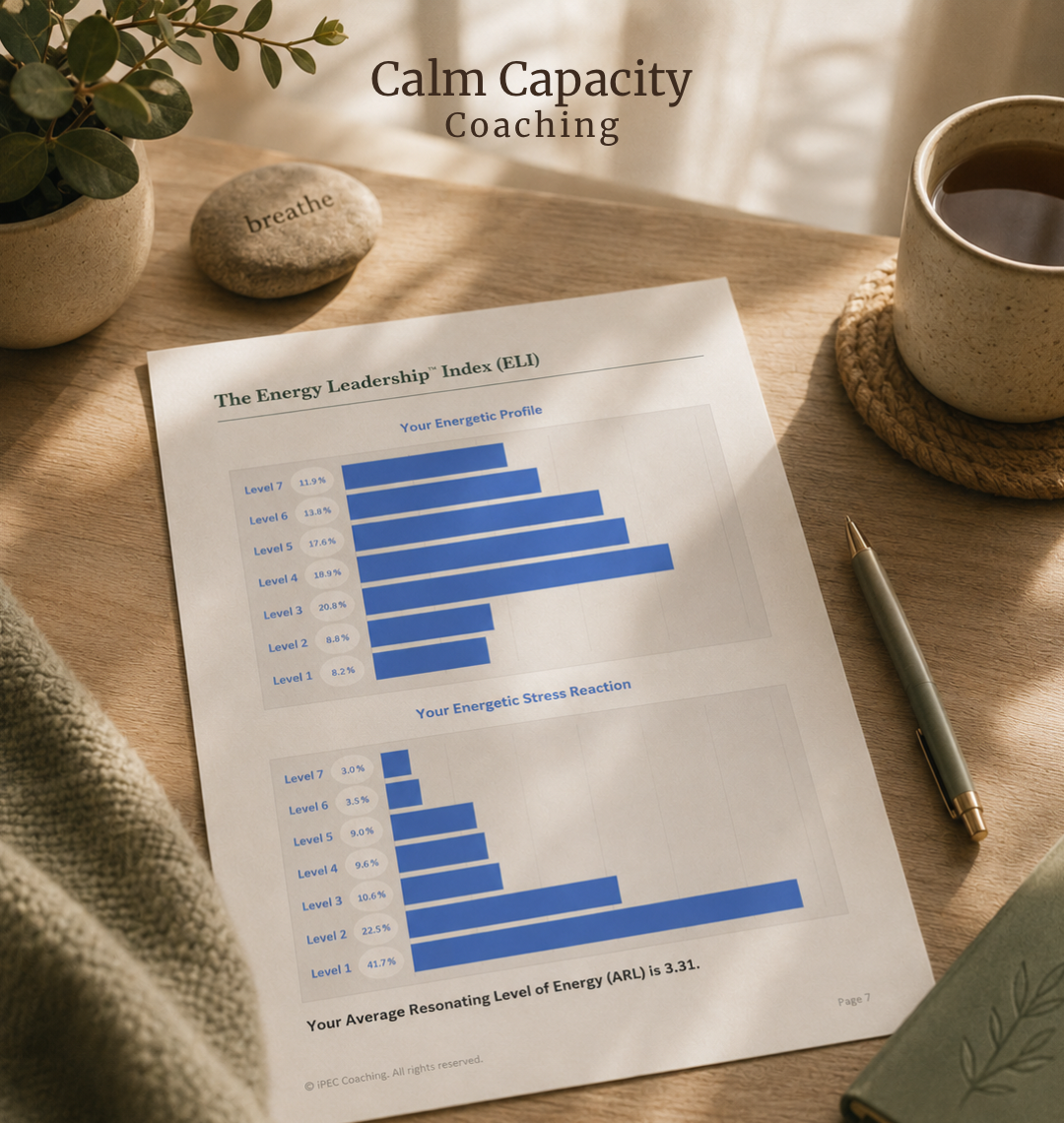
The assessment produces two profiles for each person:
– One under normal conditions — your everyday default
– One under stress — what happens when pressure or symptoms arrive
The interesting part is the difference between them.
WHAT THIS IS, AND WHAT IT ISN’T
This is not a typology. It is not a measure of how evolved or self-aware you are. The lower levels are not failures, and the higher levels are not achievements.
Here is the reframe Calm Capacity Coaching makes with this data. The lower levels — helplessness, conflict, control — are what a nervous system in protection mode looks like from the inside. The higher levels — care, presence, ease, spacious awareness — are what regulation looks like from the inside.
The seven levels become a way to read where your nervous system is, not who you are.
THE SEVEN LEVELS IN PLAIN TERMS
Level 1 — Helplessness. The sense that life is happening to you. That pressure, pain, or fatigue arrive as inescapable forces. A small amount is normal — most people carry some residual worry. A lot of it under stress means the system is reading the situation as an unavoidable threat.
Level 2 — Conflict and control. The energy that fights back. Pushes against difficulty. Braces. At baseline, this can be useful — it lets you advocate, set limits, push back against what isn’t working. Under stress, it shows up as tightening, guarding, overworking — the system trying to hold things together by force.
Level 3 — Responsibility and coping. The energy of “I’ll handle it.” Personal agency, self-management, the ability to keep functioning. Healthy at baseline. Under stress, though, this becomes invisible effort — the inner work of managing yourself while the outside still looks fine. You are still showing up, still capable, still producing. The cost just isn’t visible to anyone but you.
Level 4 — Care and concern for others. Genuine relational investment. Compassion, service, attunement. A real strength at baseline — often a source of meaning. Under stress, if you collapse from care directly into helplessness, the relational investment may be functioning as your trigger. When the people you care about feel threatened or disappointing, your system reads that as the threat.
Level 5 — Holding complexity. The capacity to sit with competing demands and unresolved situations without urgency. To reconcile rather than collapse into binary thinking. When this is well-developed at baseline, it shows up as inner calm — the ability to hold a lot without it feeling like a lot. Losing this under stress is a sign that your tolerance for complexity is narrowing precisely when you need it most.
Level 6 — Synthesis and intuition. Systemic thinking. The sense of how things connect. Creative intuition. The kind of thinking that happens when your mind is spacious rather than narrowed.
Level 7 — Presence and non-judgment. The most expansive state. Genuine ease. Non-reactive awareness. The capacity to observe what is happening without immediately needing to interpret, defend, or fix it.
THE GAP IS THE THING
What if the most important information in the report isn’t in either profile, but in the distance between them?
For most people, the difference between their everyday profile and their stress profile is substantial. That difference is the inner distance your nervous system travels every time something activates it. The cost of bracing, managing, holding things together. The work no one sees.
The wider the gap, the more your system is doing in the background to keep things looking fine on the outside.
Two people with similar daily profiles can have completely different stress profiles. One stays roughly the same under pressure. The other becomes almost unrecognisable to themselves. The gap is what is at stake.
WHAT COLLAPSES FIRST
Levels 6 and 7 — synthesis, intuition, presence, ease — are the first to go. Most people lose them entirely under pressure.
This is not a moral failure. It is a structural reality. The nervous system, when it shifts into protection, prioritises survival functions and stops investing energy in the wider, more spacious capacities. Intuition becomes inaccessible. The ability to see the whole picture narrows. Calm becomes something you remember rather than something you can reach.
When you see this in your own report — that quality of ease you have on a good day, gone almost entirely on a difficult one — it is often a moment of recognition. Most people already know this from experience. They just have not seen it laid out before.
A WINDOW INTO THE NERVOUS SYSTEM
This is where the ELI does something it was not originally designed to do, and does it well.
The two profiles together produce a structural picture of how your nervous system organises itself — at ease, and under pressure. Four things show up clearly when you read them this way.
How far you travel under pressure. The gap between your two profiles. This is the most direct view of how much inner work it takes you to maintain functioning when difficulty arrives. A narrow gap means your system stays roughly the same under pressure. A wide gap means the version of you under stress is operating from a substantially different place than the version of you at ease.
Where your stress energy goes. Two people can have an almost identical everyday profile and respond completely differently under pressure. Some systems collapse into helplessness. Others tighten into control. Others hold things together through sustained inner management while looking fine externally. The shape of the stress profile tells you which pattern is yours.
How much of your spacious capacity holds. Levels 6 and 7 — ease, intuition, presence — are the most fragile under pressure. How much of them remains accessible when you are activated tells you whether your tolerance for difficulty is wide or narrow. This is often the most useful single piece of information in the report.
What functioning is costing you. If your everyday profile is rich in the upper levels — care, complexity, presence — and your stress profile is dominated by helplessness or control, you are maintaining a high-functioning life through significant inner effort. The cost is real, even if no one can see it.
THE FOUR PATTERNS
When you look at enough of these reports alongside how people actually describe their lives, four patterns show up repeatedly. They are not categories you fit into. They are descriptions of how a nervous system can organise itself when it is carrying load. Most people recognise themselves primarily in one, with elements of others.
THE QUIET CARRIER
Steady on the outside. Reliable. Often the person others lean on. The pattern is subtle — ambient vigilance, a background sense that more effort is required than should be necessary, a quality of always slightly bracing without quite knowing what for.
The everyday profile is often rich in the upper levels — meaningful presence at Level 4, Level 5, and some access to Levels 6 and 7. The baseline reads as a capable, relationally invested, perceptive person operating with a fairly wide range. Helplessness and conflict at baseline are typically low.
Under stress, the shift is not dramatic. Levels 6 and 7 reduce — the spaciousness recedes. Level 1 rises moderately rather than dominating. Level 4 often partially holds. The stress profile is not a collapse. It is a quiet drift downward across the upper levels combined with a moderate rise in the lower ones.
The signature: the gap between baseline and stress is real but not dramatic. What stands out is the quiet erosion of ease — the upper levels softening without the lower levels taking over forcefully. The person doesn’t look activated. They look slightly less themselves. Because nothing dramatic is happening in the numbers, the pattern can be easy to dismiss. The cost is in the small, steady reduction of ease across daily life — not in any single visible activation event.
THE HIGH-ACTIVATION COMPRESSOR
The pattern arrives fast and visibly. The shift from ease into reactivity, urgency, or hypervigilance has a short arc. The person knows they “go there” — into the bracing, the snapping, the wired tightness. They can describe it in detail. What they cannot yet do is interrupt it early enough.
The everyday profile is often a strong, functional baseline. Level 3 is usually well-developed. Levels 4 and 5 are present. There can be meaningful Levels 6 and 7 — these are people who, on a good day, are sharp, present, and capable of holding a lot.
Under stress, the change is unmistakable. Level 2 rises significantly — often above 20–25 percent — and frequently dominates the stress profile. Level 1 typically rises alongside it as a secondary presence, sitting underneath the bracing. Levels 6 and 7 collapse — often dramatically, sometimes to almost nothing. Level 5 typically drops sharply as well.
The signature: stress L2 dominant, L1 secondary, sharp L5–L7 collapse. The combined draining energy under stress is high. The gap between baseline and stress is wide. The person becomes a substantially different version of themselves under pressure. The system meets activation by tightening. The bracing and control are the protection response. The helplessness sitting underneath is what the bracing is defending against. The spacious capacities go offline because the system has narrowed everything down to fight the pressure.
THE HIGH-INVISIBLE-EFFORT CARRIER
The classic high-functioning presentation. Composed. Effective. Often the person who looks like they are managing everything well — sometimes impressively well. The gap between external effectiveness and inner effort is the defining feature.
The everyday profile is often the most impressive-looking baseline of the four. Strong Level 3. Meaningful Level 4. Often substantial Level 5, and real access to Levels 6 and 7. The everyday profile reads as a high-functioning, integrated, capable person. The constructive energy across Levels 4 through 7 combined is often above 60 percent.
Under stress, this is where the pattern becomes distinctive. Rather than collapsing into helplessness or tightening into control, the stress profile is dominated by Level 3 — sustained coping energy, often rising above 20 percent. Levels 1 and 2 are present but not dominant. Levels 6 and 7 reduce — the ease and spaciousness recede — but Level 3 absorbs most of the stress energy.
The signature: high constructive baseline, stress L3 dominant, wide gap between the two profiles, large drop in the upper levels even though Levels 1 and 2 don’t take over dramatically. What is striking is how much constructive energy collapses — the gap between a richly developed baseline and a stress profile dominated by sustained inner coping work.
There is a subtle variant worth knowing about. Sometimes the stress profile looks unusually flat — no level dominating, gap narrow, the report appearing calm. In someone carrying high invisible effort, this can mean the stress response itself is being regulated. The person is so practised at managing themselves that even the stress profile presents tidily. The narrow gap looks like ease and is actually a particular kind of managed presentation. The way this becomes visible is in the conversation around the report rather than in the numbers alone.
The system maintains functioning through sustained inner work. The performance is real and the cost is also real. Most of the activation goes into self-management rather than visible reaction.
THE AVOIDANCE-ORGANISED PATTERN
Life has organised itself around what to avoid. Activities, situations, or relationships that previously felt accessible have gradually receded. The avoidance is rarely dramatic. It is usually quiet — a slow narrowing of what is engaged with, often without a conscious decision to narrow.
The everyday profile often shows meaningful Level 4 — sometimes high, above 18 percent. Level 3 is usually present but may be lower than in the Invisible-Effort Carrier. Levels 5, 6, and 7 vary widely — some people in this pattern retain meaningful access to them; others have already lost a lot of that ground.
Under stress, Level 1 dominates the stress profile — often above 30 percent, sometimes higher. Level 2 may be present but is usually secondary or low — the system is not fighting back; it is collapsing inward. Levels 6 and 7 typically collapse significantly. Level 4 often drops sharply too — the care orientation that was strong at baseline largely vanishes under pressure.
The signature: stress L1 dominant, high baseline L4 reducing significantly under stress, with the system moving from a care-rich baseline into a helplessness-dominated stress profile. The combined draining energy under stress is high, driven mostly by Level 1 rather than Level 2. The gap can be very wide — sometimes the widest of the four patterns.
The combination of high baseline care plus collapse into helplessness under stress often indicates that relational investment is functioning as the activation trigger. When relationships feel threatened, disappointing, or unsafe, the system reads that as the threat and collapses. The avoidance is the strategy that has built up over time to prevent that collapse from happening — by avoiding the situations, conversations, or activities that risk triggering it. The narrowed life is the protection.
HOW THE PATTERNS BLEND
Most people are not purely one pattern. The patterns blend, and the blend matters.
A common blend is Compressor with Avoidance — someone whose stress profile shows both high Level 2 and high Level 1, with no strong relational driver at baseline. The system oscillates between fighting back and giving up, depending on which strategy is available. Tolerance for complexity is usually significantly reduced.
Another is Invisible-Effort Carrier with Quiet Carrier elements — high baseline care, sustained coping energy under stress, moderate helplessness underneath. The person is managing a service or care-oriented life through sustained inner work, with the cost showing up as steady erosion of ease rather than dramatic activation.
The blends are normal. What matters is recognising the primary signature first — which pattern is doing the most work to maintain functioning — and reading the others as context. When the primary pattern shifts through the work, the secondary patterns often shift with it.
WHAT CHANGES WHEN CAPACITY EXPANDS
The aim is not to make you more “Level 7.” It is to expand the underlying nervous system capacity, so that more of who you are at ease remains available when difficulty arrives.
When that begins to happen, the ELI shows it in specific ways. The gap between your two profiles narrows — not because you have capped your daily life, but because your stress state has moved closer to your baseline. The helplessness and bracing reduce. The capacity for care, perspective, and ease starts to hold under pressure rather than collapse.
That is the structural change this work is designed to produce. Not “feeling better” — that is sometimes a side effect. The structural change is that less of you disappears when life gets hard.
ONE LAST NOTE
The ELI is one window into the nervous system, not the whole picture. It measures attitudinal orientation, which is real and useful, but not the same as direct nervous system measurement.
None of what is described here is meant to fit you neatly. It is meant to make something visible that has usually been operating below conscious awareness for a long time. When the pattern becomes legible — when you can see the specific shape your nervous system makes under pressure, in numbers, on paper — something changes. Not because the numbers are the truth. Because seeing the pattern is the beginning of being able to work with it rather than be run by it.
That, more than anything, tends to be what people find useful. Not a label. A way to recognise themselves more clearly than they had before.