
You made it through the day. The deadline, the difficult conversation, the thing that should have upset you more than it did — you handled all of it without missing a beat. Then you sat down that evening and your body fell apart: a headache, a wave of exhaustion, a tightness in your chest that has nothing to do with anything happening right now. The feeling didn’t disappear when you didn’t have time for it. It went somewhere.
If this is familiar, you’ve probably built a genuine skill: staying composed while something is actually happening. It’s useful. It’s also not free, and the invoice tends to arrive later, in a different currency, in a place that makes it hard to trace back to what caused it.
The skill of staying composed, and what it costs
Most people who describe themselves as good under pressure didn’t set out to become that way. It was built, meeting by meeting, difficult conversation by difficult conversation, out of necessity. Something happens, there’s no room to feel it right then, so you set it aside and keep moving. Over enough repetitions, setting it aside stops feeling like an effort. It becomes automatic, which is exactly why the cost is easy to miss — the moment where you might have noticed the toll never happens, because your system has gotten efficient at skipping past it.
Emotion is a physical event, not only a mental one
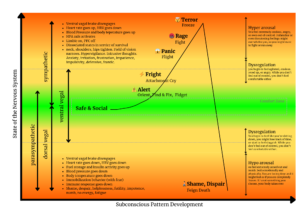
An emotion isn’t just a thought or a judgment about what happened. It’s a physical event: a quickening, a tightening, a surge of energy through the body, whether the feeling is anger, grief, or relief. In an ordinary case, that physical charge rises and then it moves through and settles. The body registers it, does something with it, and returns to baseline.
When there’s no room for that — when the schedule, the setting, or the habit of composure cuts the process off partway — the charge doesn’t get the chance to complete. It doesn’t vanish either. It gets parked. And a body that has learned to park activation instead of letting it move through builds up a backlog, the same way any system does when input keeps arriving faster than it gets processed.
Why the bill shows up somewhere else, later
This is the part that makes the pattern hard to see: the parked activation rarely announces itself as “unfinished feeling from Tuesday’s meeting.” It shows up as a tension headache on Wednesday, a wave of exhaustion that seems disproportionate to the day, a short temper over something small, or a body that simply won’t settle even though nothing is wrong right now. Because the release happens later and elsewhere, most people never connect it to its source. They just notice they feel worse than the day seems to justify, and assume that’s what being busy does to a person.
It’s worth being specific about the difference this points to. Suppressing a feeling doesn’t make it go away — it interrupts it mid-process and leaves the charge in storage. Completing a feeling means the physical part of it gets to run its course, however briefly, so there’s nothing left over to store.
Composure versus completion
None of this is an argument against staying composed when composure is actually needed. You can’t fall apart in the middle of a client call, and most people don’t want to. The distinction that matters is between composure as a pause — set the feeling aside for now, come back to it — and composure as a permanent skip, where “for now” never actually arrives. If nothing in your day or week is built to let that pause end, the pause becomes the whole story, and the backlog keeps growing.
A small practice for an ordinary day
You don’t need a dramatic release to close the loop. What tends to help is much smaller and more frequent: a few minutes, on a normal day, where you let yourself notice what’s actually present in your body — not to analyze it, not to explain it, just to let whatever charge is there move without immediately redirecting it into the next task. That might be a short pause between meetings instead of straight back-to-back, a walk without your phone, or simply sitting still long enough to notice tension you’ve been carrying without registering it. The goal isn’t a big emotional scene. It’s giving activation somewhere to go before it accumulates into something you feel later without knowing why.
A capacity question, not a willpower one
If this pattern is familiar, it isn’t a sign that you’re bad at managing your emotions or that you need more discipline. It’s a sign that your system has gotten very good at postponing, and postponing has limits. Capacity, in this sense, isn’t about trying harder to feel your feelings on schedule. It’s about building enough room in an ordinary day that activation has somewhere to complete, so it stops showing up later as a headache, a crash, or a body that won’t settle for reasons you can’t quite name.
If you recognize this pattern — composed in the moment, paying for it afterward in ways that don’t obviously connect — that’s often a sign the gap is in capacity, not effort. Start here to see which of the three paths fits what you’re noticing, or book a call to talk it through directly.