
Calm Capacity Coaching
The exhaustion that sleep doesn’t fix. The tension that’s always there, just below the surface. The sense that you’re holding it together, but it costs more than it should. Pain that keeps coming back. A body that never quite feels safe and relaxed.
These experiences have something in common. They’re not signs of damage or weakness — they’re signs of a system that learned to stay on guard. And what is learned can be updated.
Calm the alarm · Build capacity · Live with more Ease
“I finally understood what was happening in my body — and for the first time in years, things started to change.”
— M.T., coaching client
A First Check
Many people who find their way here have spent months or years trying to understand what is happening in their body.
Medical tests may come back normal or inconclusive. Treatments may help for a short time, but the symptoms return. And over time it becomes harder to relax, harder to trust the body, and harder to feel at ease.
Many people begin to wonder:
“Is something seriously wrong with me?”
“Why can’t my body calm down?”
“Why does everything feel harder than it should?”
In many cases, these experiences are connected to learned nervous system patterns — patterns that can be understood and changed.
This is exactly the work we do here.
– Your symptoms are real.
– Your nervous system is doing exactly what it learned to do.
– And it can learn something new.
Why this happens
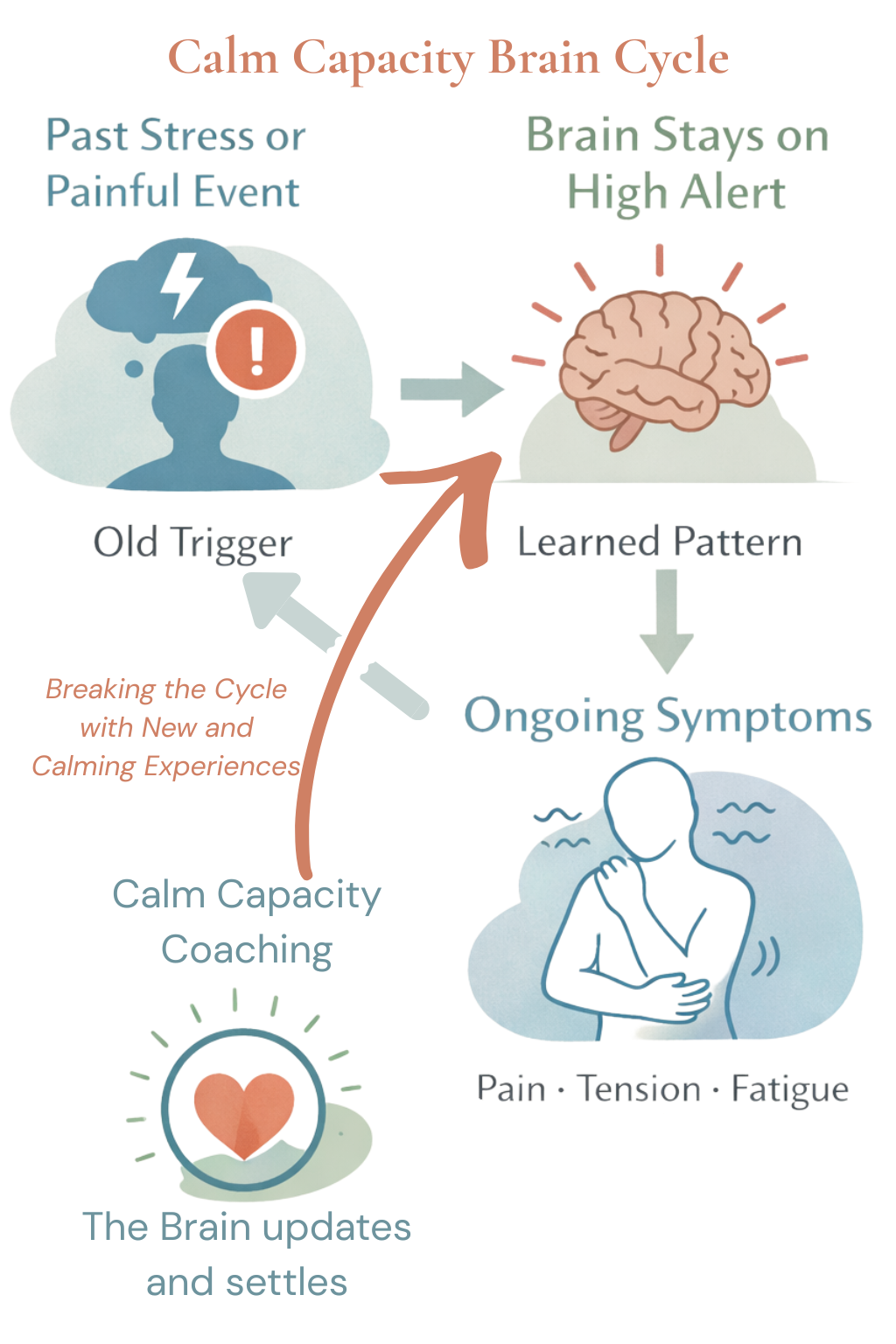
When the brain perceives a potential threat — physical or emotional — it activates protective responses in the body. Muscles tighten. Stress hormones increase. Pain signals may appear to make sure we pay attention.
This system is incredibly useful in true danger.
But sometimes the nervous system learns to stay in protection mode even after the original threat has passed.
When that happens, the brain continues sending alarm signals even though the body itself is structurally safe.
This can show up as:
Nothing about these symptoms is imagined.
The signals are real.
They are simply being generated by a nervous system that has learned a protective pattern.
The encouraging part is this:
Because these patterns are learned, they can also be updated.
Through specific experiences and guided practice, the brain can learn that the body is safe again.
As this learning takes place, the alarm response gradually settles — and many symptoms begin to change.
This is the foundation of the work we do in Calm Capacity Coaching.
When the nervous system begins to settle, people often notice small but meaningful shifts.
The body feels less braced.
Sleep becomes deeper.
Pain signals soften or become less frequent.
The mind becomes quieter.
Everyday situations require less effort.
These changes do not happen because you force the body to relax.
They happen because the nervous system learns that it no longer needs to stay on high alert.
Over time, this creates more room for ease, clarity, and a more peaceful experience of life.

Your Coach
After years working with leaders under chronic stress, I kept encountering the same pattern: brilliant, capable people held back not by mindset — but by a nervous system stuck in a state of threat. That led me deep into the neuroscience of stress and pain, and eventually to certification in Pain Reprocessing Therapy.
I work with people who are exhausted from trying and still suffering. My approach is compassionate, evidence-informed, and built on one core belief: your brain learned this pattern, and it can learn a different one.
Calm Capacity Coaching brings that work together into one approach — for chronic pain, persistent stress, and anyone who simply wants more inner room. The methodology is the same: work with the nervous system, not against it.
Together we calm the overactive alarm, and gradually expand your window of capacity — so that calm becomes your nervous system’s new default. Sessions are conducted online, one-to-one, at a pace that respects where you are right now.
The Process
We explore your pain history together to identify the nervous system patterns that keep symptoms active — with curiosity, not judgment.
You learn to relate to pain and stress signals differently — shifting from fear and threat toward safety and calm. This is where real change begins.
Through gentle, practical practices, your nervous system gradually learns new defaults — expanding your window of capacity so that calm becomes your new baseline, not just a moment of relief.
Who This is For
Calm Capacity Coaching serves people at different points on the same spectrum — all rooted in the same nervous system science, all addressed with the same compassionate approach.
The Science
Chronic pain, persistent stress, and a perpetual sense of tension share a common mechanism: a nervous system that has learned to treat certain signals as dangerous, and keeps sounding the alarm even when the original threat is long gone.
This is not a flaw. It is the nervous system doing exactly what it was designed to do — protect you. The challenge is that these protective patterns can become self-sustaining, keeping you stuck in cycles of pain, exhaustion, or reactivity that no amount of willpower can simply override.
Neuroplastic pain occurs when the brain continues to produce pain signals even after tissue has healed, or without any structural injury at all. The nervous system has learned to associate normal body sensations with danger, triggering a protective pain response. Research suggests this accounts for the majority of chronic pain conditions.
Stress is not just mental — it is a full-body nervous system state. When the threat response is chronically activated, the body stays in a state of physiological tension: elevated cortisol, tight muscles, disrupted sleep, impaired digestion, and a persistent sense that something is wrong. Calm Capacity Coaching helps the nervous system find its way back to regulation.
Coaching is not therapy and works at the level of skills, patterns, and nervous system education rather than psychological diagnosis or treatment. Unlike mindfulness — which cultivates awareness — Calm Capacity Coaching works specifically with the brain’s threat response and how it can learn to interpret signals as safe. Many clients have tried mindfulness or CBT with limited results before finding this work to be the missing piece.
A landmark 2022 randomised controlled trial published in JAMA Psychiatry found that Pain Reprocessing Therapy — the evidence base at the heart of this work — led to significant and lasting reductions in chronic back pain, with 66% of participants pain-free or nearly pain-free after treatment. Effects were maintained at one-year follow-up.
Client Experiences
“
I’d been told by doctors there was nothing structurally wrong. After six months of coaching with Jan, I understand why I was in pain — and I’m genuinely living again. The fatigue is gone. The back pain I had for four years is almost completely resolved.
— M.T., 42 · Chronic back pain, 6 years
“
The neuroscience explanations finally made sense of something I’d lived with for years and couldn’t explain. Jan never made me feel like I was a failure or it was my own fault. For the first time I felt understood and supported to actually change things.
— S.K., 38 · Stress-related symptoms
“
I was deeply skeptical. I’d tried everything. But the way Jan explains how the nervous system works — it clicked. Over the course of Jan’s coaching I noticed I was moving without bracing for pain. That hadn’t happened in years.
— A.R., 51 · Fibromyalgia symptoms
Common Questions
Calm Capacity Coaching is most relevant for chronic back pain, chronic headaches or migraines, fibromyalgia, chronic fatigue, stress-linked physical symptoms, and pain that persists after injuries have healed. A self-assessment tool is available on this site to help you evaluate whether your symptoms are likely neuroplastic.
Everyone’s journey is different. Some people notice significant shifts in 4–6 sessions; others benefit from a longer engagement over several months. We always start with a free introductory conversation to understand your situation before recommending an approach.
All sessions are conducted online via video call, making this accessible wherever you are. Sessions are typically 60 minutes and scheduled flexibly around your life.
No — coaching is not therapy and no referral is needed. Calm Capacity Coaching is an educational and skills-based approach. If you are in active mental health crisis, I will always recommend working with a licensed clinician alongside or instead of coaching.
No! Your pain is 100% real and generated by your body. What we’re addressing is the mechanism that keeps it going — which is a brain process, not a character flaw or psychological weakness. The pain is real; the pathway to change it runs through the nervous system.
Mindfulness and CBT work primarily with thoughts and attention. Calm Capacity Coaching works specifically with the nervous system’s threat response — the biological layer beneath thought. Many clients have tried mindfulness and CBT with limited success before finding this to be the missing piece.
Free Resource
Most people try to change how they feel by changing how they think. And wonder why nothing really sticks. This short guide explains what’s actually happening in your nervous system — and what genuinely helps it settle.
Free. No commitment. Immediately useful.
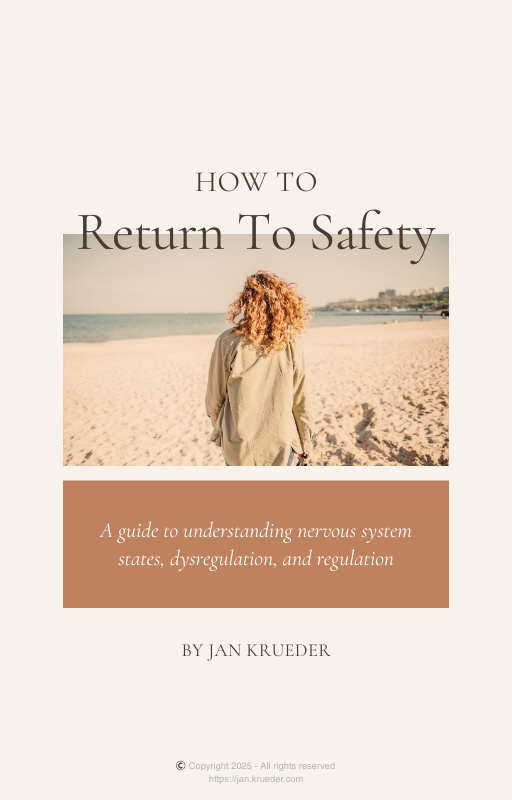
Returning to Safety
Why stress, anxiety, and reactivity happen — and what actually helps.
Ready when You are
A confidential, no-pressure call to explore whether this work is a good fit for where you are right now. No commitment required.
Typically 30 minutes · Online · Completely confidential