
Calm Capacity Coaching is built on a single insight: persistent pain, chronic stress, and a constant sense of being overwhelmed are not character flaws or permanent states. They are patterns a nervous system learned — and patterns it can unlearn.
The Calm Capacity Approach
The Calm Capacity Approach
This Approach is For
Chronic pain
Persistent pain without clear structural cause, or long after an injury has healed.
Chronic stress
Sustained overwhelm, exhaustion, or burnout that doesn’t resolve with rest.
Calmer Life
Functioning, but wanting more inner room, calm, and resilience
What Is Calm Capacity Coaching?
For years, Jan worked with people experiencing chronic pain using Pain Reprocessing Therapy — a structured, evidence-based approach that helps the brain reinterpret pain signals as safe rather than dangerous. The results were profound. But over time, a broader truth became clear.
The same nervous system mechanism that sustains neuroplastic pain also sustains chronic stress, emotional reactivity, and the persistent sense that everything is harder than it should be. The brain learns a pattern of threat. The body stays braced. And no amount of willpower, positive thinking, or trying harder changes the underlying state.
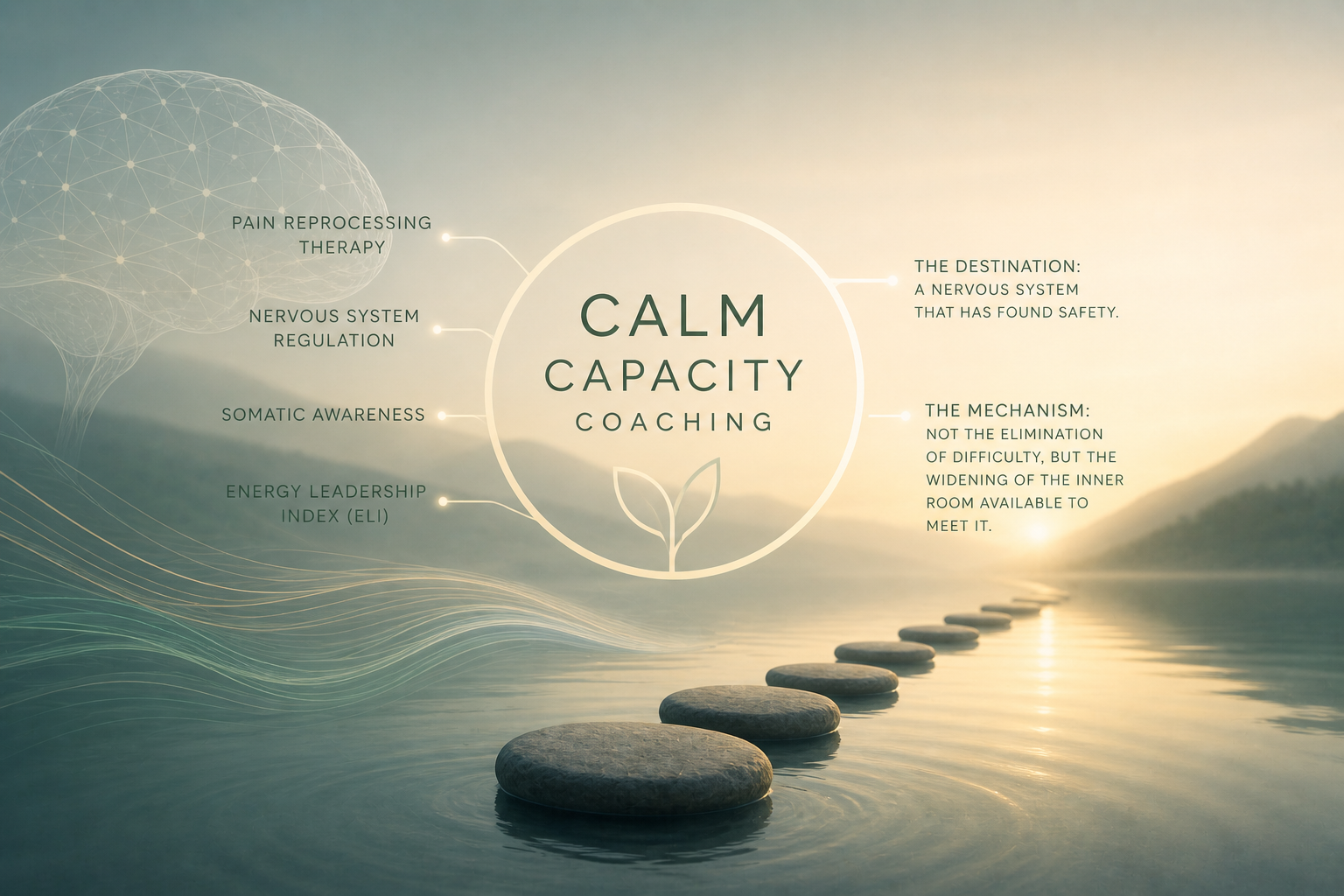
Calm Capacity Coaching names this broader work. It brings together Pain Reprocessing Therapy as its primary evidence base, alongside nervous system regulation science, somatic awareness practices, and the Energy Leadership Index (ELI) — a research-backed attitudinal assessment that makes visible the energy patterns sustaining chronic stress and dysregulation — into one coherent approach that serves anyone whose nervous system has learned to stay in protection mode.
The word calm reflects the destination: a nervous system that has found safety. The word capacity reflects the mechanism: not the elimination of difficulty, but the widening of the inner room available to meet it.
"The nervous system is not a fixed thing. It is an adaptive system that learned to protect you — and it can learn something new."
- Jan Krueder
The Four Pillars
Calm Capacity Coaching draws on four interlocking bodies of science and practice. None of them alone is sufficient — it is their combination that makes lasting, measurable change possible.
Primary Evidence Base
Pain Reprocessing Therapy (PRT)
Developed at the Pain Psychology Center and validated in a landmark randomised controlled trial, PRT is a structured approach to helping the brain reinterpret chronic pain signals as safe. It works by reducing fear around symptoms, interrupting the pain-fear cycle, and teaching the nervous system that certain sensations do not indicate danger. It is the clinical foundation of this work — and its principles apply far beyond pain alone.
Regulatory Science
Drawing on polyvagal theory and autonomic nervous system science, this pillar addresses how the body moves between states of safety, mobilisation, and shutdown — and what helps it return to regulation. Chronic stress, burnout, and emotional dysregulation are understood not as psychological failures but as physiological states. The work focuses on expanding what researchers call the “window of tolerance” — the range within which the nervous system can engage flexibly with life.
Body-Based Awareness
The nervous system does not communicate in words. It communicates through physical sensation — tightness, heaviness, a held breath, a racing heart. Somatic tracking is the practice of learning to observe these signals with curiosity rather than alarm. This shifts the relationship between person and symptom from fear to understanding, and creates the conditions in which the nervous system’s threat response can begin to settle.
Attitudinal Awareness
The Energy Leadership Index (ELI) is a research-backed attitudinal assessment that reveals how you are currently investing your energy — and how that shows up under both normal conditions and stress. For clients in chronic pain or stress patterns, the ELI makes visible the catabolic energy states (apathy, conflict, reactivity) that often run beneath the surface and feed nervous system dysregulation. Understanding where your energy is going is the first step to consciously redirecting it.
The Science
Your nervous system has one primary job: keeping you alive. To do this, it continuously scans the environment — and your body — for signals of safety or threat. When it detects something that resembles danger, it mobilises a protective response: muscle tension, a racing heart, heightened vigilance, or pain.
This happens automatically and beneath conscious awareness, through a process neurologist Stephen Porges calls neuroception — the body’s continuous, pre-conscious threat detection system. It operates far faster than rational thought, and it is not particularly concerned with accuracy. In the face of ambiguity, it defaults to protection.
Under normal circumstances, this is exactly right. The problem arises when the system gets stuck.
The nervous system learns through pattern recognition, not reasoning. When a sensation, emotion, or situation was present during a moment of threat or intense stress, the system encodes that entire pattern as potentially dangerous. Later, even a partial match — a familiar sensation, a similar environment — can trigger the same protective response. Over time, if the alarm is never updated, ordinary life begins to feel like a constant low-level threat. The nervous system is doing exactly what it was designed to do. It has simply learned the wrong lesson about what is safe.
It can look like chronic pain that persists despite normal scan results and healed tissue. It can look like persistent exhaustion that doesn’t improve with rest. It can look like anxiety, reactivity, difficulty concentrating, or a sense of always bracing for something to go wrong. It can look like emotional numbness, social withdrawal, or a quiet feeling that something is off. These are not signs of weakness or dysfunction — they are signs of a nervous system that has learned to stay in defence, even when the original threat is long gone.
Researcher Daniel Siegel described what he called the “window of tolerance” — the range of arousal within which a person can function without becoming dysregulated. Below it, the nervous system shuts down. Above it, it goes into overwhelm. Within it, there is flexibility, clarity, and the ability to respond thoughtfully rather than react automatically. Chronic stress and persistent pain narrow this window considerably. The core goal of Calm Capacity Coaching is to widen it — to expand the inner room available so that more of life can be met with steadiness rather than survival.
Yes — and this is perhaps the most important thing to understand. The nervous system is neuroplastic: it physically changes in response to experience. This is how patterns of protection become entrenched, and it is also how they can be updated. Neuroplasticity is not just a hopeful idea — it is measurable. The 2022 JAMA Psychiatry trial of Pain Reprocessing Therapy used brain imaging to document changes in pain-processing regions following treatment. The brain that learned to produce chronic pain also learned to stop. The same capacity for change applies across all nervous system states.
Safe & Connected
Calm, present, socially engaged. The nervous system is regulated and available for growth, learning, and restoration.
Goal
Mobilised (Fight / Flight)
Alert, reactive, stressed. Heart rate elevated, muscles braced, attention narrowed. Helpful acutely; damaging chronically.
Common
Shutdown (Freeze / Collapse)
Numb, disconnected, exhausted. The system conserves energy when overwhelm has become too great to mobilise against.
Common
Based on Polyvagal Theory (Porges, 1995) and the Window of Tolerance model (Siegel, 1999). Calm Capacity Coaching supports movement from defensive states toward safe engagement.
Key Insight
Chronic symptoms — whether pain, stress, or persistent overwhelm — are often not the problem itself. They are the nervous system’s protection strategy. The work is to help the system update what it believes it needs protecting from.
Pain Reprocessing Therapy
Pain Reprocessing Therapy (PRT) was developed by Alan Gordon at the Pain Psychology Center in Los Angeles and is the primary evidence-based methodology within Calm Capacity Coaching. It was designed specifically for neuroplastic pain — chronic pain that is generated by the brain’s overactive alarm system rather than by ongoing tissue damage.
The central insight of PRT is that fear is the fuel of chronic pain. When we interpret pain as evidence of danger, the brain receives confirmation that its alarm was warranted — and amplifies the signal. When we learn to relate to pain with curiosity rather than alarm, the signal loses its urgency. This is not about denying pain or overriding sensation with positive thinking. It is about updating the brain’s threat assessment at the level where it actually operates.
PRT was tested in a rigorous randomised controlled trial published in JAMA Psychiatry in 2022. The results were striking: two thirds of participants who received PRT were pain-free or nearly pain-free after four weeks of treatment — compared with one in five in the placebo group and one in ten in the usual care group. Brain imaging confirmed that the changes in pain were accompanied by measurable changes in how pain-processing regions of the brain responded to stimuli. A follow-up study published in 2025 confirmed that these gains were largely maintained five years later.
The principles of PRT — reducing threat perception, interrupting fear-pain cycles, building nervous system safety — extend naturally beyond pain into chronic stress and general nervous system dysregulation. This is the bridge that Calm Capacity Coaching builds.
This happens automatically and beneath conscious awareness, through a process neurologist Stephen Porges calls neuroception — the body’s continuous, pre-conscious threat detection system. It operates far faster than rational thought, and it is not particularly concerned with accuracy. In the face of ambiguity, it defaults to protection.
Under normal circumstances, this is exactly right. The problem arises when the system gets stuck.
Neuroplastic (or nociplastic) pain is chronic pain generated by the central nervous system — specifically by a brain that has learned to interpret safe body signals as dangerous. It is not imagined, exaggerated, or a sign of weakness. It is physiologically real pain, produced by real neural processes. The distinction matters because structural treatments (surgery, physiotherapy, medication) cannot address a pattern held in the brain’s threat detection system. That is what PRT is designed to reach.
Sessions combine psychoeducation (understanding why the brain generates pain), somatic tracking (learning to observe sensations with curiosity rather than fear), addressing catastrophic thinking and protective avoidance patterns, and gentle experiments that help the nervous system accumulate evidence of safety. The work is guided, structured, and paced to the individual — never pushing beyond what the system can tolerate.
The clinical evidence base for PRT is strongest for chronic pain. However, the underlying mechanisms — nervous system sensitisation, fear-driven amplification of symptoms, the role of threat perception in maintaining dysregulation — apply equally to chronic stress and burnout. Calm Capacity Coaching applies these principles more broadly, drawing on related nervous system regulation frameworks for clients whose primary concern is stress rather than pain.
Rsearch Evidence
of PRT participants were pain-free or nearly pain-free after four weeks of treatment
Follow-up data confirms treatment gains were largely maintained at five years post-treatment
of chronic back pain cases have no identifiable peripheral cause — the majority are neuroplastic in origin
Ashar et al., JAMA Psychiatry (2022). Effect of Pain Reprocessing Therapy vs Placebo and Usual Care for Patients with Chronic Back Pain: A Randomized Clinical Trial.
Ashar et al., JAMA Psychiatry (2025). Pain Reprocessing Therapy vs Placebo and Usual Care: 5-Year Follow-Up.
Energy Leadership Index
Nervous system science explains the body’s automatic protective responses. But there is another layer of the same pattern that often goes unseen: the attitudinal energy we bring to our experience — the filters through which we interpret events, relate to our pain or stress, and decide (often unconsciously) what is possible for us.
The Energy Leadership Index (ELI) is a research-backed attitudinal assessment developed by iPEC that makes this layer visible. Unlike personality tests such as Myers-Briggs or DiSC — which describe stable traits — the ELI is an attitudinal assessment. It captures not who you are, but how you are currently showing up: the energy patterns you bring to work, relationships, health, and life under both ordinary and stressful conditions.
The ELI maps your experience across seven levels of energy — from the most contracted and draining states (levels 1 and 2, described as catabolic) to increasingly expansive and constructive ones (levels 3–7, described as anabolic). It also reveals your Average Resonating Level (ARL): a single number representing where your energy tends to rest as a baseline. Research across more than 30,000 participants shows that people with a higher ARL report significantly greater satisfaction across all areas of life.
What makes this relevant to Calm Capacity Coaching is the precise overlap between catabolic energy and nervous system dysregulation. Level 1 energy — characterised by apathy, a sense of having no choice, and victim thinking — maps closely onto the shutdown state of a chronically stressed nervous system. Level 2 energy — anger, conflict, resistance — mirrors the mobilised fight-or-flight state. These are not just mindsets. They are physiological positions the nervous system has learned to default to. Seeing them as energy levels rather than personal failings changes the conversation entirely.
Used at the start of coaching, the ELI gives us a clear, concrete picture of your current energetic landscape — including how it shifts under stress. This becomes a baseline and a compass: not to judge where you are, but to understand it, and to see the direction of travel as your nervous system finds more safety.
Personality tests describe stable traits — they tell you what kind of person you are and suggest working with that. The ELI measures something different: your current attitudinal stance toward your life and circumstances. Because attitude is dynamic rather than fixed, the ELI is not a static label. It is a snapshot that can change — and tracking that change over time is one of the most tangible ways to see coaching progress.
The online assessment takes approximately 20 minutes to complete. It is followed by a dedicated 60–90 minute ELI debrief session with Jan, where your results are explored in depth: your seven energy level percentages under normal conditions and under stress, your Average Resonating Level, and — most importantly — what your specific profile reveals about the patterns most worth paying attention to in our work together.
The ELI can be offered as a standalone assessment and debrief, or as an integrated part of the Calm Capacity Coaching programme. For clients who want a clear starting point — a tangible picture of their current energetic and attitudinal baseline before the deeper nervous system work begins — it makes a powerful opening to the process.
Jan is a certified ELI Master Practitioner (ELI-MP) — an advanced designation from iPEC that certifies practitioners in the full administration and debrief of the Energy Leadership Index. The ELI is exclusively available through iPEC-certified coaches.
x This is not
✓ This is
Every person’s journey is different. But the underlying arc of the work follows a consistent progression — beginning with the ELI assessment as a concrete point of departure. The Calm Capacity Coaching approach spans over three layer, from pattern recognition, over capacity expansion,, to the integration into every day life.
The Energy Leadership Index (ELI) establishes your attitudinal and energetic baseline before the layer work begins. It makes the nervous system’s protection patterns visible in concrete, measurable terms — a shared starting point and compass for everything that follows.
We map the protection pattern with precision — when the nervous system’s alarm activates, what situations and sensations trigger it, and what the underlying threat appraisal is running beneath. Naming the pattern clearly and without judgment is the first structural intervention: much of what keeps protection patterns entrenched is the confusion and self-blame layered on top of them.
Fear is the central mechanism that keeps the protection pattern running. Once the pattern is named, we work directly with the nervous system’s threat response — addressing catastrophic thinking, protective avoidance, and hypervigilance with gentleness and precision. The goal is not to suppress these responses but to help the nervous system update its assessment of what actually requires protection.
The nervous system updates through experience, not argument. We design small, specific experiments that give it direct evidence of safety — moments when what was predicted to be threatening turns out to be manageable, or even neutral. Each piece of evidence doesn’t just change a belief; it begins to update the underlying prediction the nervous system runs.
As safety evidence accumulates, the nervous system’s alarm threshold rises and its tolerance window widens. The range of experience that can be met without protective bracing expands. What previously triggered a full threat response begins to feel manageable — not through suppression, but because the underlying threat assessment has genuinely shifted.
Expanded capacity built in session is the beginning, not the outcome. Integration is the work of transferring what changed in session into the actual conditions of daily life — the relationships, pressures, and situations where the old pattern ran. Real-life experiences become the working material. The goal is structural change: a nervous system that holds its expanded capacity under load, not one that expands in session and reverts under pressure.
The OFFER
Whether you are looking at the Chronic Pain, Chronic Stress & Burnout, or Life Balancing offers of Calm Capacity Coaching, there are three programme formats available — each designed for a different starting point, depth of engagement, and level of direct support from Jan. The right choice depends on your path, your situation, and how you work best.
All three formats draw on the same underlying methodology — the Inner Capacity Architecture. What differs is the depth of work, whether sessions with Jan are included, and which layers of the methodology are addressed.
SELF-DIRECTED · LAYER 1 · Signal Recognition & Pattern Identification
Six weeksSelf-directed — no 1:1 sessions – Does not include the ELI
The Access-Tier Programme is a structured six-week self-directed programme that delivers the foundation of the Inner Capacity Architecture — the nervous system education, pattern recognition tools, and Layer 1 practices that form the basis of all the work.
You work through the material at your own pace, without sessions with Jan. The programme is designed for people who learn well independently and want a clear, structured framework before deciding whether to go further — or who want a solid foundation in the methodology regardless of what follows.
The ELI assessment is not part of this format. It is integral to the 1:1 engagements and becomes available if you move to the Pattern Recognition or Capacity Engagement.
WHAT THIS PROGRAMME PRODUCES
Completion of Layer 1: the ability to name your primary nervous system protection pattern, understand its mechanism, and begin applying first-layer practices independently. You leave with a working framework and a clear map of what the deeper work would involve.
THIS PROGRAMME IS A GOOD FIT IF
1:1 WITH JAN · LAYER 1 · Signal Recognition, Pattern Identification, ELI baseline
Six sessions – 1:1 with Jan – Includes ELI at session 1
The Access-Tier Programme is a structured six-week self-directed programme that delivers the foundation of the Inner Capa
The Pattern Recognition Engagement is a six-session 1:1 engagement scoped to a single specific outcome: a precise, working understanding of your nervous system’s protection pattern — what it is, when it activates, and how to observe it with distance in real time.
It is not a shortened version of the Capacity Engagement. It is a distinct offer whose legitimate scope is understanding the pattern, not changing it structurally. This distinction matters and is held accurately throughout.
WHAT THIS PROGRAMME PRODUCES
Completion of Layer 1: the ability to name your primary nervous system protection pattern in real time, with observational distance during activation. You leave with the ELI baseline, a precise map of your pattern, and a clear understanding of what structural change would require. This is the foundation for deeper work — and stands on its own as a meaningful outcome.
THIS PROGRAMME IS A GOOD FIT IF
1:1 with Jan · Full arc · All paths
Six sessions – 1:1 with Jan – Includes ELI at session 1
The Capacity Engagement is the primary 1:1 offer and delivers the complete three-layer Calm Capacity arc: Signal Recognition (Layer 1), Capacity Expansion (Layer 2), and Integration (Layer 3). It is available on all three paths and produces structural change — a measurably different nervous system baseline.
The engagement includes the ELI at baseline (sessions 1–2) and at completion (Layer 3). Both administrations are built into the engagement — not optional additions. The before-and-after ELI comparison is the primary quantitative evidence of completion, alongside the four observable capacity indicators tracked across the engagement arc.
WHAT THIS PROGRAMME PRODUCES
Structural change in the nervous system’s default operating state: an expanded Alarm Threshold (greater tolerance before the protection response activates), a widened Tolerance Window (broader range of sustainable engagement), a shorter Recovery Arc (faster return to regulation after activation), and a reduced Protection Load (less ongoing background activation). These shifts are measurable via ELI ARL movement and the four capacity indicators.
THIS PROGRAMME IS A GOOD FIT IF
The same nervous system science underlies all three. What differs is the presenting experience — and how we frame the work together.
For people with persistent pain that has outlasted its structural cause — or never had one. PRT is the primary methodology here, with the strongest evidence base.
For people whose nervous system is chronically mobilised — wired, tired, reactive, or simply unable to fully switch off, regardless of external circumstances.
For people who aren’t in crisis but recognise a pattern of contraction — less ease, less spaciousness, less access to their own clarity — and want to change it.
Next Steps
The first step is a free, confidential conversation — no commitment, no pressure. A space to share what you’re experiencing and find out whether this work feels like the right fit.